
Case history · Infrastructure · 2024
Advanced air mobility: Dronitaly, Bologna Fair
The challenge
Vertiports, the infrastructures for urban transport by drone shuttle, are a type of intermodal facility with no established regulatory precedent: comprehensive European rules are expected only by 2030. Designing their safety means anticipating scenarios that have never been observed before.
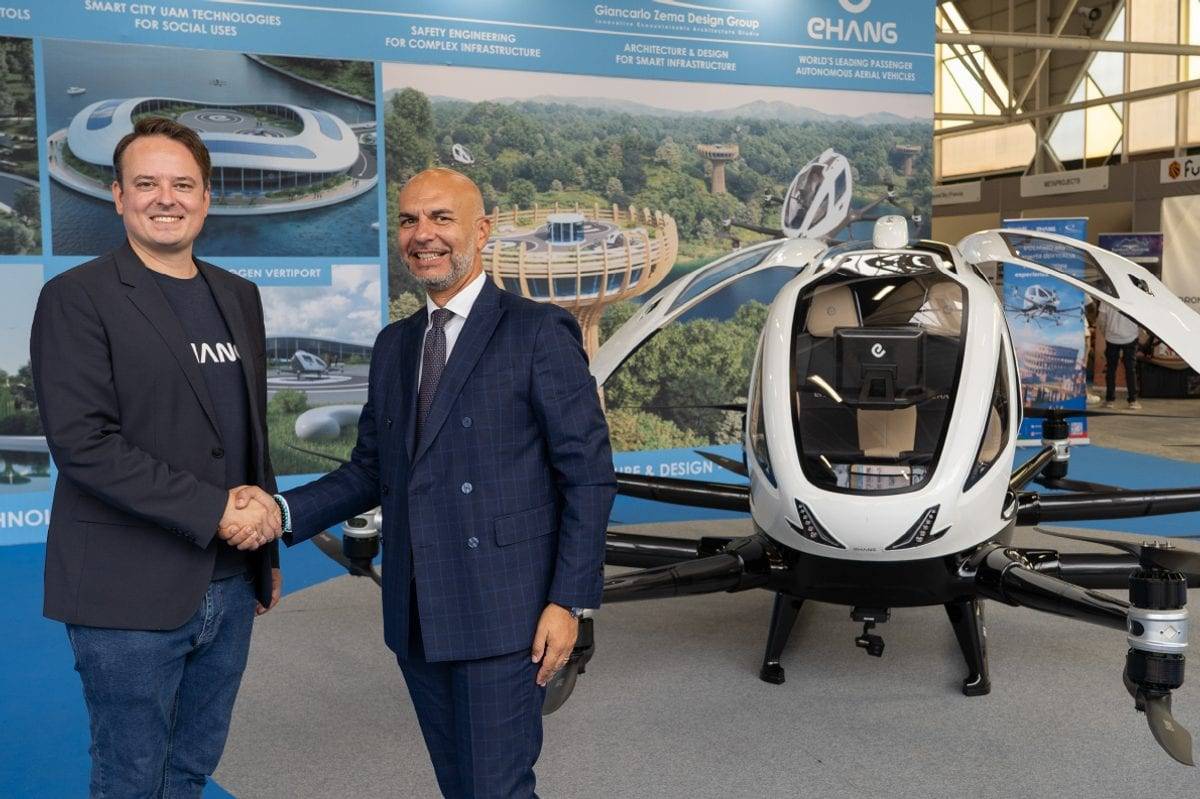
The emerging infrastructures linked to Advanced Air Mobility (AAM) and Urban Air Mobility (UAM) find here a natural point of contact with Polis Consulting's long-standing expertise. The company specializes in safety engineering for infrastructures open to the public, with recognized experience in the railway, motorway and airport sectors: that very body of knowledge becomes the starting point for the new infrastructures of air mobility.
The approach
For the Varese vertiport, Polis Consulting developed a complete egress simulation: a model of the structure, incident scenarios and evacuation dynamics, following the performance based approach of fire engineering. Safety entered the project before the infrastructure itself did.
At the heart of the method are innovative performance based models and algorithms that go beyond the prescriptive approach. This is not about applying predefined rules to a building type that still has no rules, but about demonstrating and designing the coexistence, within the same infrastructure, of different transport systems. It is a shift in perspective that makes it possible to approach an unprecedented structure by starting from the expected safety performance rather than from prescriptions that do not yet exist.
Simulations and interference risk
The coexistence of multiple transport systems within the same building introduces a specific risk: interference risk, that is, the residual risk arising from the interaction between different systems affecting the public using the facility. To manage it, Polis Consulting relies on fire, egress and emergency simulations.
By modeling the development of a fire, evacuation dynamics and emergency scenarios, it is possible to measure and minimize the residual interference risk, verifying that the simultaneous presence of multiple transport modes does not compromise the safety conditions of people.
An inclusive infrastructure
The infrastructures designed by Polis Consulting natively adopt inclusive models for public access and egress. Inclusion is not an afterthought, but a requirement built in from the very conception of the project.
The goal is to guarantee equal conditions for everyone, both in the ordinary use of the infrastructure and in emergency situations, when the ability to enter and exit safely becomes decisive for each person.
A model: FS Sistemi Urbani
The experience with FS Sistemi Urbani represents an important early real world model of urban intermodality. The choice to equip railway stations with dedicated UAM infrastructure outlines a transport model common to the most significant urban regeneration projects.
In this context, Polis Consulting's contribution made it possible to design the drone infrastructure above the railway infrastructure, ensuring that the overlap of the two systems did not increase the overall risk for users. It is concrete proof that the coexistence of rail transport and air mobility can be safely engineered, one piece of a broader regeneration of cities.
The outcome
The simulation was presented by Eng. Ciro Cannelonga at the Dronitaly event at the Bologna Fair: a concrete contribution to defining the safety standards of advanced air mobility in Italy.

Let's talk about your project.
Tell us about your context: an engineer will answer you, not a salesperson.